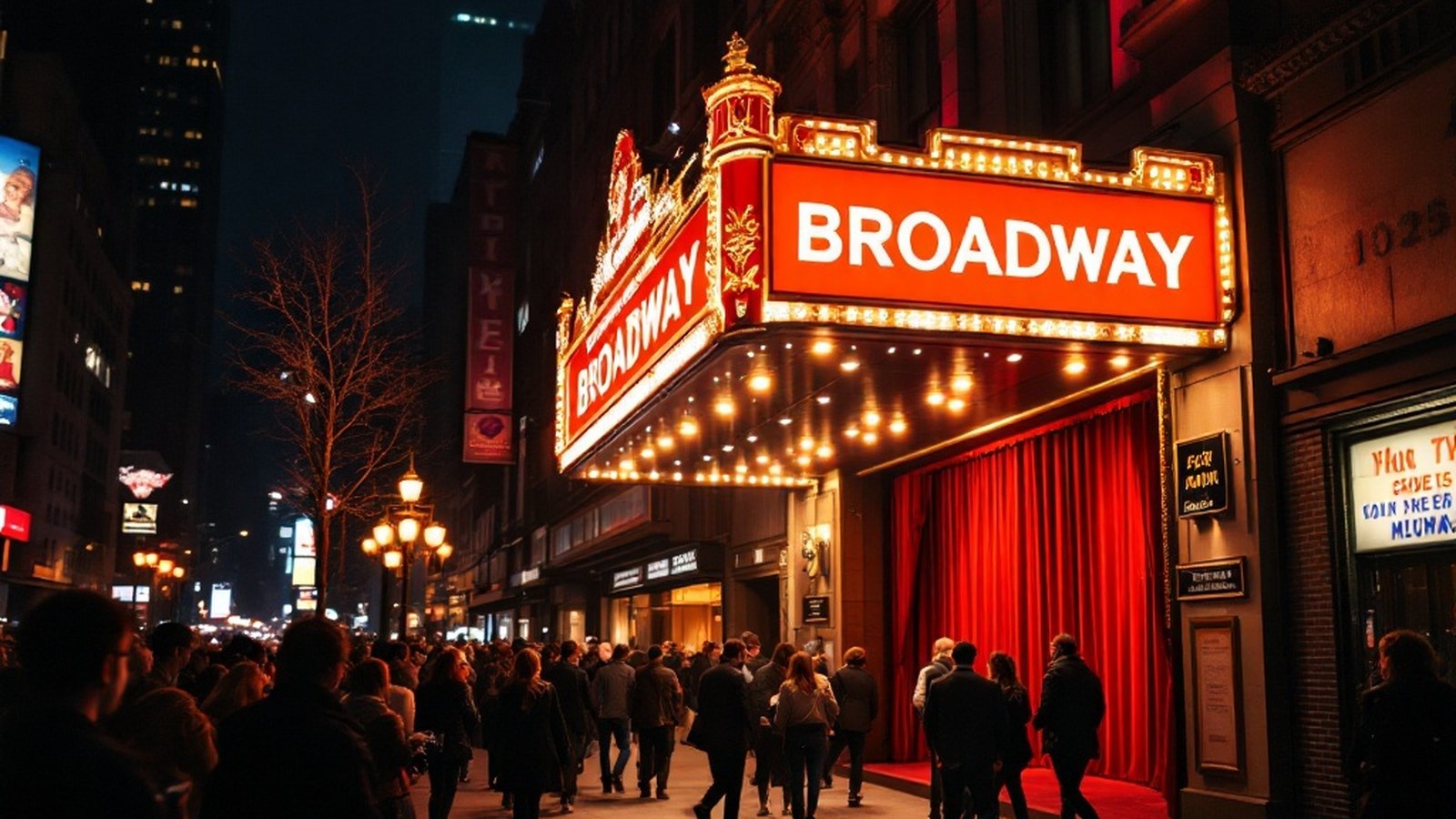
Walk into almost any Broadway house on any given night and read the room — not the stage, the room. The chandeliers, the plush seats, the crowd filing in from 45th Street, the playbill vendors, the white wine in plastic cups. What you see, overwhelmingly, is a particular kind of audience: older, whiter, more affluent than the city that built these theatres, more tourist than neighbor.
The room tells you everything before the curtain rises
New York is among the most diverse urban environments on earth, a city where no single racial group commands a majority, where dozens of languages echo in a single subway car. The Broadway house, by and large, does not reflect that city. It reflects the city's anxiety about who culture is for.
The gap is not a mystery. It is a choice, made season after season.
This is not a new critique. It is not even a controversial one — theatre executives will nod along at panels, promise pipeline programs, commission reports. And then the season opens, and the rosters look much as they always have, and the stages tell the stories they have always preferred, and the audiences who might have found themselves there do not come, because nothing on those boards was aimed at them, and nothing in that room was designed to make them feel they belonged.
The casting problem is also a writing problem
Representation onstage begins long before opening night. It begins in the writers' rooms and the development labs, in the commissions handed out and the workshops funded and the residencies extended. When the Roundabout Theatre Company or the Manhattan Theatre Club program a season, or when the Shubert Organization books a house, the pipeline they draw from reflects decades of investment — or the lack of it.
Playwrights who are Black, Indigenous, Latine, Asian American, or from any number of other communities that have been structurally sidelined don't appear on mainstage rosters because they have been absent; they appear less frequently because they have been developed less, produced less, reviewed less, and celebrated less, in a self-reinforcing cycle the field has been slow to interrupt.
The numbers are real even if they shift incrementally. Studies of Broadway seasons across the 2010s consistently showed that the large majority of productions were written by white writers, directed by white directors, and led by predominantly white casts. Off-Broadway did modestly better; Off-Off-Broadway, unshackled from the economics of a fourteen-hundred-seat house, often did better still.
Lin-Manuel Miranda's Hamilton — whatever one makes of its politics of representation — proved that racially diverse casting in canonical American stories could drive a commercial phenomenon, not merely satisfy a progressive obligation. The lesson was heard, partially. Diverse casting became more fashionable in revivals. But fashion is not structural change.
Audiences follow invitation
The audiences are there. They are in the Bronx and in Flatbush and in Jackson Heights and in Flushing, and they go to theatre — community theatre, church theatre, school theatre, storefront theatre — with genuine hunger. What they do not do, by and large, is spend a hundred and fifty dollars to sit in a Shubert house and watch a story that was not written for them. That is not a failure of appetite. That is a failure of invitation.

The Non-Traditional Casting Project, founded in the 1980s, was an early institutional attempt to articulate what equitable casting might look like. The Theatre Development Fund has long run access programs that lower the financial barrier — TKTS, subsidies, outreach. These are real and necessary. But discounted tickets to a show that doesn't speak to you is a partial solution at best. Price is a barrier; so is cultural relevance; so is the accumulated signal, sent across decades, that this art form was made by and for someone else.
Companies that have genuinely shifted this — the tradition of community-rooted, artist-of-color-led companies — understand something the commercial theatre is still learning: the audience and the art have to be developed together. You don't build a diverse audience by programming one show a season you describe in your press release as "a story for all New Yorkers." You build it by being in relationship with communities over time.
| The three houses | Broadway | Off-Broadway | Off-Off-Broadway |
|---|---|---|---|
| Scale | 500–1,900 seats | 100–499 seats | Under 100 seats |
| Economics | Highest overhead; investor-backed | Leaner; often nonprofit | Almost no money; maximum risk |
| Where the honest work lives | Occasionally | More often | Most consistently |
What a more honest house would look like
Honesty, in this context, is structural. It means asking not just "who is onstage?" but "who wrote this, who directed it, who designed it, who runs the company, who sits on the board, who controls the money, who gets the commission?" A more honest house is one that has pursued equity at every one of those levels simultaneously — not as a diversity initiative bolted on to an unchanged institution, but as a rethinking of the institution's purpose.
Progress exists — expanded recognition, seasons that feel genuinely different. It is also true that progress at this pace, in a city this diverse, is a form of slowness that functions like resistance.
Some companies are doing this work with real seriousness. The Vineyard Theatre has a track record of nurturing writers larger institutions have not yet embraced. The Signature Theatre's playwright-residency model has created the conditions for sustained development that short-run commercial logic can never offer. Off-Off-Broadway, for all its precarity, continues to produce the most formally adventurous and the most demographically honest theatre in the city — often simultaneously, because the two things are connected.
The theatre keeps forgetting to seat whole swaths of this city. The seats are there. The writers are there. The audiences are waiting.
— the closing argument of this piece
The theatre has extraordinary power to tell a community who it is and who it might become. Every season, every programming decision, every hire is an argument about whose stories matter. A more honest house would make a different argument — not as a moral corrective, but because the stories it is currently leaving on the table are the most alive, most necessary, and most dramatically interesting stories available.