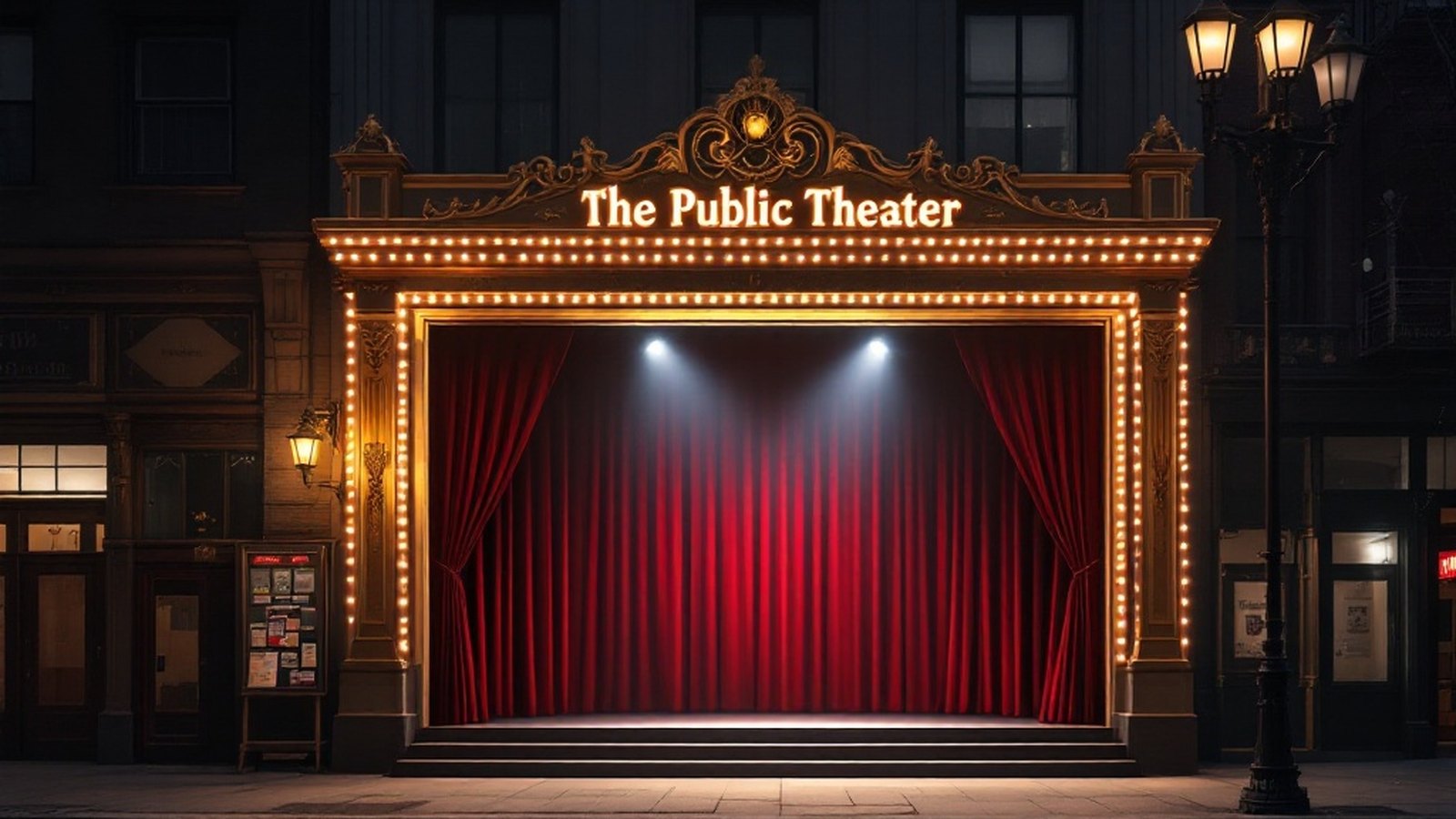
The promise on Lafayette Street
There is a line that New York's Public Theater has been living inside — and sometimes against — for decades: that theatre belongs to everyone. Joseph Papp built the institution on exactly that conviction, dragging Shakespeare out of the academy and into Central Park in the late 1950s, founding a free outdoor festival that survives to this day. The Shakespeare in the Park program at the Delacorte Theater remains the most visible proof that the promise still has a pulse. On any given summer evening, New Yorkers who couldn't dream of affording an orchestra seat at the St. James or the Majestic are sitting on a hillside watching a world-class production for nothing. That is not a small thing.
The building on Lafayette Street — the former Astor Library, landmarked and gloriously strange — houses five stages under one roof, ranging from the Newman, a proper thrust-stage theater, down to the Joe's Pub cabaret room. That variety matters. It allows the Public to hold a large-scale musical and a ten-seat workshop reading in the same week, to be both an institution and a laboratory at the same time. Very few producing organizations in the city can make that claim honestly. The Roundabout Theatre Company and Manhattan Theatre Club operate with comparable institutional weight, but neither has the Public's particular combination of populist mythology and genuine formal range.
James or the Majestic are sitting on a hillside watching a world-class production for nothing.
What the promise costs
The tension is real, though, and it would be dishonest to write about the Public without naming it. The organization that gave the world A Chorus Line and Hair — both of which transferred to Broadway and generated revenue that funded downtown operations for years — is also an institution that has navigated the chronic contradiction of the nonprofit theater: the closer you get to the mainstream, the harder it is to be genuinely radical. Hamilton, developed at the Public before its Broadway transfer, is the loudest recent example. The production changed the commercial theatre landscape and made Lin-Manuel Miranda a household name; it also generated enormous resources for the institution. Whether that windfall bought the Public more freedom or quietly adjusted what freedom meant is a question worth sitting with.
The institution has made real commitments to new voices — Oskar Eustis's long tenure as artistic director was defined in part by an investment in writers and communities historically excluded from the American stage. The Public's mobile unit, which brings productions into correctional facilities and underserved neighborhoods, is among the most substantive access programs any producing organization in the city runs. These are not press-release gestures. They cost money and logistical will, and they reach people who are not at the table in any conventional sense.
The ongoing argument
What makes the Public worth arguing about — worth loving and criticizing in the same breath — is precisely that it has never stopped presenting itself as answerable to something larger than its own survival. Most institutions, faced with that kind of self-imposed obligation, quietly retire it. The Public keeps the rhetoric live, which means it keeps the accountability live too.
Who the theatre keeps forgetting to seat is a question that applies with particular force to an institution that defines its mission as democratic. The free tickets, the mobile unit, the multilingual programming — these are genuine; they are also always partial, always insufficient against the scale of the city's exclusions. That is not a condemnation. It is the permanent condition of any institution serious enough to make the promise at all.
The Public is not the people's theatre. It is an argument for one — ongoing, unresolved, worth watching.